


Cart
0

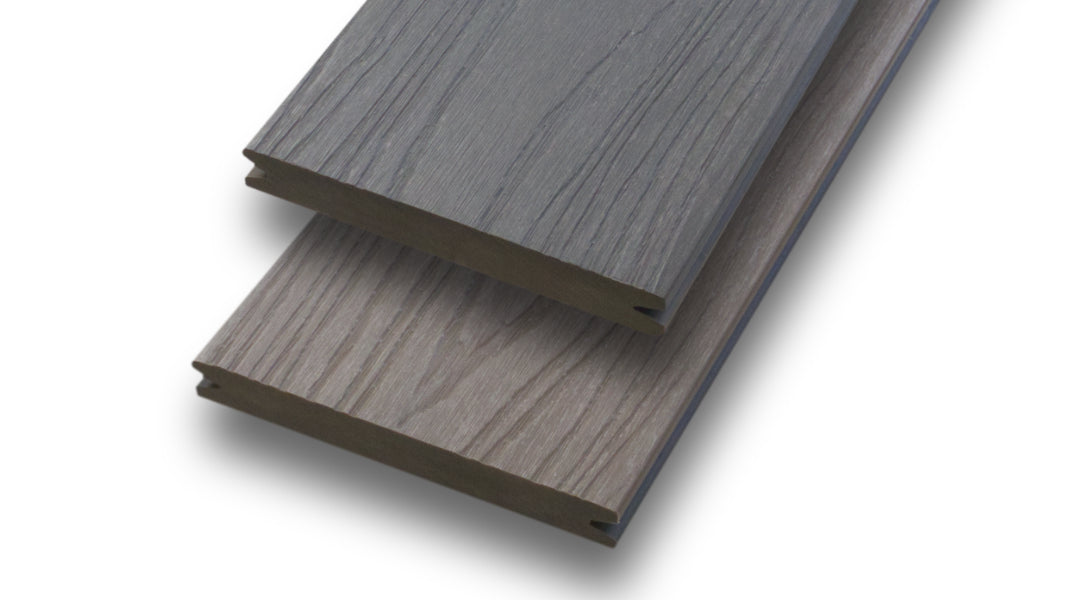
Anyone deciding on a WPC deck is quickly faced with the next question: Solid board or hollow-chamber board – and what does "CoEx" actually mean? In the Gunreben range, you will find three types of boards: the solid SOLID board, the hollow-chamber HOLO 4 board, and the solid SOLID CoEx board with a co-extruded surface. This article shows what distinguishes the three variants and which projects they are suitable for.
You can find all available boards, colors, and surfaces in our WPC deck boards collection.
A quick guide to help you decide
- SOLID (solid, 22 × 143 mm): completely solid cross-section, large selection of colors and surfaces – from ribbed and grooved to saw-rough to an aged look.
- HOLO 4 (4 chambers, 22 × 146 mm): hollow-chamber profile with four chambers, lighter than a solid board and generally more affordable. The open ends are sealed with end caps.
- SOLID CoEx (solid, 20 × 143 mm): solid board with an additional, co-extruded protective layer on the surface. For anyone looking for an easy-care surface with a protective layer and texture.
Regardless of the board type, the following applies: substructure, fasteners, and expansion gaps must be matched to the WPC system.
What is WPC anyway?
WPC stands for Wood-Plastic-Composite. Our SOLID and HOLO 4 boards consist of around 60% wood fibers (poplar), 35% polyethylene, and 5% additives, including those for UV and mold protection. As a result, WPC combines a wood-like appearance with properties that are particularly appreciated for maintenance and walking barefoot: the boards are splinter-free and do not need to be oiled.
An important difference from wood: WPC reacts primarily to temperature. The boards expand in length when it is warm and contract when it is cold. This behavior must be taken into account during installation – more on that below. Anyone still wavering between wood and WPC can find an overview of wood types in the article Hardwood deck boards in comparison.
WPC SOLID: the solid all-round board
The WPC SOLID is a solid deck board in the 22 × 143 mm format. The full cross-section provides a solid, stable feeling underfoot. Since there are no chambers, the cut edges are also solid – end caps are not required.

Its strength is primarily the selection. The SOLID board is available in versions including:
- ribbed and grooved in dark gray, light gray, dark brown, and light brown – e.g., SOLID light gray ribbed or SOLID dark brown grooved,
- fine and coarse saw-rough for a natural-looking, wood-like texture – e.g., SOLID dark gray coarse saw-rough,
- French-profiled as well as with 3D texture – e.g., SOLID light gray French or SOLID dark gray 3D texture,
- in an aged look in anthracite, stone gray, sand, and terra – e.g., SOLID anthracite aged or SOLID Terra aged.
Suitable for: decks and balconies where appearance and surface variety are a priority, as well as for areas like pool surrounds with WPC.
WPC HOLO 4: the hollow-chamber board with four chambers
The WPC HOLO 4 in the 22 × 146 mm format has four chambers inside. This makes it lighter than a solid board, which is noticeable during transport and installation. At the same time, it is generally cheaper than a solid board.

The HOLO 4 is available in dark gray, light gray, and light brown, each ribbed or grooved – e.g., HOLO 4 light gray ribbed or HOLO 4 light brown grooved.
With hollow-chamber boards, the chambers are open at the ends. For a clean finish, they are sealed with suitable end caps for WPC deck boards or clad with an edge angle or a cover strip.
Suitable for: budget-conscious projects, larger areas, and builders who prefer a lighter board – with the small extra effort for edge finishing.
WPC SOLID CoEx: solid with a protective layer
The WPC SOLID CoEx in the 20 × 143 mm format is also a solid board. The difference lies in the surface: with co-extrusion, an additional protective layer is applied to the WPC core in one operation. According to the manufacturer, this makes the surface more resistant to UV radiation, moisture, and weather influences; stains are easier to remove.

All CoEx boards have a textured surface. There are eight shades to choose from – from cool gray tones such as slate gray, granite, iron gray, and cement to warm brown tones such as honey brown, caramel brown, tobacco, and mocha.
Suitable for: heavily used areas, dining areas on the deck, and anyone who wants as little maintenance as possible.
Overview: SOLID, HOLO 4, and CoEx in comparison
| Criterion | WPC SOLID | WPC HOLO 4 | WPC SOLID CoEx |
|---|---|---|---|
| Structure | solid | hollow chamber (4 chambers) | solid with co-extruded protective layer |
| Format | 22 × 143 mm | 22 × 146 mm | 20 × 143 mm |
| Surfaces | ribbed, grooved, saw-rough fine/coarse, French, 3D texture, aged | ribbed, grooved | textured |
| Colors | gray, brown, and aged tones | dark gray, light gray, light brown | 8 gray and brown tones |
| Weight | heavier | lighter | heavier |
| Edge finish | solid cut edge | end caps or trim strip required | solid cut edge |
| Lengths | Fixed lengths 3.0 m / 3.6 m / 4.2 m / 4.8 m | ||
What is important during installation – for all three boards
Substructure
WPC boards are installed on a WPC substructure – such as the WPC substructure 40 × 60 mm – or on an aluminum substructure. A substructure spacing of 30–35 cm is recommended. WPC substructures must be supported according to system specifications and are not intended for self-supporting constructions. Read more about material selection in the article Choosing a substructure for deck boards.
Fastening
The boards are fastened hidden using WPC clips. For the first row, there is the WPC starter clip; for the area, the WPC deck clip 4 mm or 7 mm – each also available in black stainless steel so that the clips are barely noticeable in the joint. A comparison of the types of fastening can be found in the article The right fastening system for deck boards.
Expansion joints
Because WPC changes in length with temperature changes, a gap of approx. 20 mm should be maintained to adjacent components such as house walls, masonry, or posts. Sufficient space must also be planned at board joints. You can find the exact specifications in the Gunreben installation tips for WPC decks.
Finishing and accessories
For visible end and side edges, color-matched WPC edge angles and WPC cover strips are suitable. You can find everything else in Accessories for WPC decks. If you want to make it easy for yourself, take a look at our WPC complete sets.
Maintenance: simple, but not maintenance-free
WPC does not need to be oiled or painted. For regular cleaning, water, a mild soap solution, and a brush are usually sufficient. For more thorough cleaning and additional protection against water, grease, and dirt, the Gunreben WPC&BPC cleaner and the WPC&BPC surface protection are suitable. Grease and beverage stains should be removed as soon as possible, especially in dining areas – this is particularly easy with the CoEx board due to the closed protective layer.
Which WPC board fits which project?
- You want a specific look – e.g., saw-rough, French, or aged? Then the WPC SOLID with its large selection of surfaces is the first choice.
- Is the budget the priority or is the area large? The WPC HOLO 4 is lighter and cheaper – plan to include end caps or cover strips.
- Is the deck heavily used, e.g., as a dining area, or would you like as little maintenance as possible? Then there is a lot to be said for the WPC SOLID CoEx with its resistant surface.
- Pool surrounds? A solid board is worthwhile here. You can find tips on this in the article Pool surrounds with WPC and in the WPC pool surround collection.
Conclusion
All three WPC boards offer the typical advantages of the material: splinter-free, barefoot-friendly, and easy-care without oiling. The differences lie in the structure: the SOLID impresses as a solid board with the largest selection of surfaces, the HOLO 4 as a light and inexpensive hollow-chamber board, and the SOLID CoEx with its co-extruded protective layer.
However, it is not just the board that is decisive, but the entire system of substructure, clips, and sufficient expansion joints. Compare all colors and surfaces now in our WPC deck boards collection and add the matching accessories directly.
